|
|
Opanas Zalyvakha - The Road to Truth
January 23 ‒ April 3, 2011
The Sounds
1995, oil on canvas
Gift of the artist
|
By all accounts, Opanas Zalyvakha was a cultural giant of
his time, a quiet and unassuming man whose measured,
philosophical approach to the oppressive forces of Brezhnev’s
regime defined Ukraine’s dissident movement. Zalyvakha’s
name is thus synonymous with the “sixties” movement of nonconformist
Soviet writers, poets, and artists, who fashioned an
alternative anti-Soviet mindset in the generation that found
its flowering in the years of the post-Stalinist Thaw. These
included the likes of the lyrical poet Vasyl Symonenko, who
inspired an entire national democratic movement before dying
at the age of 28; the charismatic literary scholar and publicist
Ivan Dziuba, who encouraged the rejection of official literary
theories brought on by Socialist Realism and boldly criticized
the Russification of Ukrainian culture; Yevhen Sverstiuk, author
of the essay “Cathedral under Construction” (Sobor u ryshtovani),
a response to Oles Honchar’s Cathedral — one of the key
novels that launched and bolstered the dissident movement of the
1960s; and a string of activist painters like Alla Horska, a kindred
spirit to Zalyvakha. Through separate expressions of defiance,
these individuals opposed Soviet rule, raised the banner of national
awareness, and fought for human rights in Ukraine at the height of
totalitarian rule in the Brezhnev era.
Zalyvakha knew firsthand the brutality of dictatorship. Born in the
eastern part of Ukraine (in the region of the former Soviet capital,
Kharkiv), where Stalin instituted inhumane measures to collectivize
the farms, Zalyvakha escaped the ravages of the forced famine
— the Holodomor of the 1930s — by fleeing with his family to
Khabarovsk, and later to Irkutsk in the Russian Far East. Zalyvakha’s
life continued to be a peripatetic one, filled with rejection and
ostracism. When his artistic talent was first discovered in 1946, he
made the long-distance journey to receive formal training at the
Repin State Institute of Painting, Sculpture, and Architecture of
the USSR Academy of Fine Arts in Leningrad; at one point, he was
temporarily suspended for behavior “unworthy of a Soviet student”
when he failed to attend a Communist Party meeting.
Before completing his studies, Zalyvakha’s required practicum took
him to the ethnically rich and artistically colorful Subcarpathian
town of Kosiv in 1957, where he rediscovered his roots and national
affiliation. In December 1961, he finally made his home in Ukraine,
first in identity-conscious Ivano-Frankivsk (formerly Stanislaviv), and
four years later in Kyiv. It is profoundly revealing that living outside
Ukraine from a tender age did not quash his national spirit; instead,
it served to strengthen his will against a regime that would seek
to erase the natural urge to express the personal right to national
identity. For the first time since his early childhood, Zalyvakha found
himself back in Ukraine among his countrymen. Sustained by the
company of like-minded intellectuals, supporters of human rights
and freedom of expression, he discovered his Ukrainian sensibilities.
Zalyvakha’s name is specifically identified with a cardinal event
of contemporary art history: the unmitigated censorship and
brutal destruction of a monumental stained-glass project for Kyiv
University. Executed in the spring of 1964, the work was intended
to commemorate the anniversary of the birth of Taras Shevchenko
(1814-1861), Ukraine’s national bard and the University’s namesake.
Zalyvakha collaborated with Horska (who was found murdered
in 1970 in the apartment of one of her relatives) and with artists
Liudmyla Semykina, Halyna Sevruk (a ceramicist), and Halia
Zubchenko to create a symbolic triptych honoring Shevchenko’s
support of freedom and democracy. The artwork interpreted
the poet’s humanist ideals with irony and gravitas, depicting
Shevchenko as a tragic sacrifice of oppression, an enchained
Promethean figure stifled by the powerful forces of totalitarianism.
The artists’ vision of their national hero was transformed into
a scene of crucifixion and lamentation; the mourning figure of
a mother clinging to her innocent child was clearly read as a
metaphor for Ukraine grieving over the loss of her hapless children.
Zalyvakha became a sacrifice of the government when, on the
morning of March 7, 1964, the date of the official review of the
Shevchenko project, he learned that his stained-glass work had
been destroyed and reduced to rubble; only a heap of broken
colored shards and luminous crushed glass remained on the site. The
shock of such unprecedented censorship spiraled into widespread
remonstrance against the Soviet authorities and was pivotal in
inaugurating the first wave of mass arrests of Ukrainian intelligentsia,
which would continue, intermittently, into the 1970s and early 1980s.
Charged with “anti-Soviet agitation and propaganda” (Article 62 of
the Criminal Code of the Ukrainian SSR) in a closed-court hearing in
September 1966, Zalyvakha was exiled and banned from painting.
He was sentenced to five years of hard labor in the faraway republic
of Mordovia, paralleling Shevchenko’s own banishment to the distant
Urals by Tsar Nicholas I a century earlier, forbidding the national bard
to paint or write over a long decade of harsh exile.
The apparent parallels between Shevchenko and Zalyvakha are
not trivial; both artists recognized their calling as painters and
employed self-portraiture to reflect, philosophically, upon their
station in life. Zalyvakha’s portrait, as seen in this exhibition, is
presented as a hagiographic image: the artist is recognized by his
attributes — a proliferation of canvases; the Hutsul ceramic pitcher;
an open book, signaling his erudition in Western philosophy; and
inkwells, indicating a life of writing. The mirror itself doubles as an
icon frame, identifying the artist with the image of Orthodox clergy
or ancient ascetics, suggestively carved at the mirror’s apex, or the
beleaguered suffering Christ in the icon known as Nerukotvornyi
(“not made by human hands”).
While incarcerated, Zalyvakha took up the medium of small
graphics, producing more than 200 bookplates (ex libris), postcards,
and thumbnail prints of his life in the camp — all of them
confiscated and destroyed. Upon his release, notwithstanding
repeated searches of his home and 15 more years of close KGB
surveillance, Zalyvakha managed to sustain himself through the
design of book covers for underground publications, portraits of
fellow non-conformists and former inmates, and local commissions
for applied, decorative interior design for cafés and restaurants.
And he continued to paint with a passion.
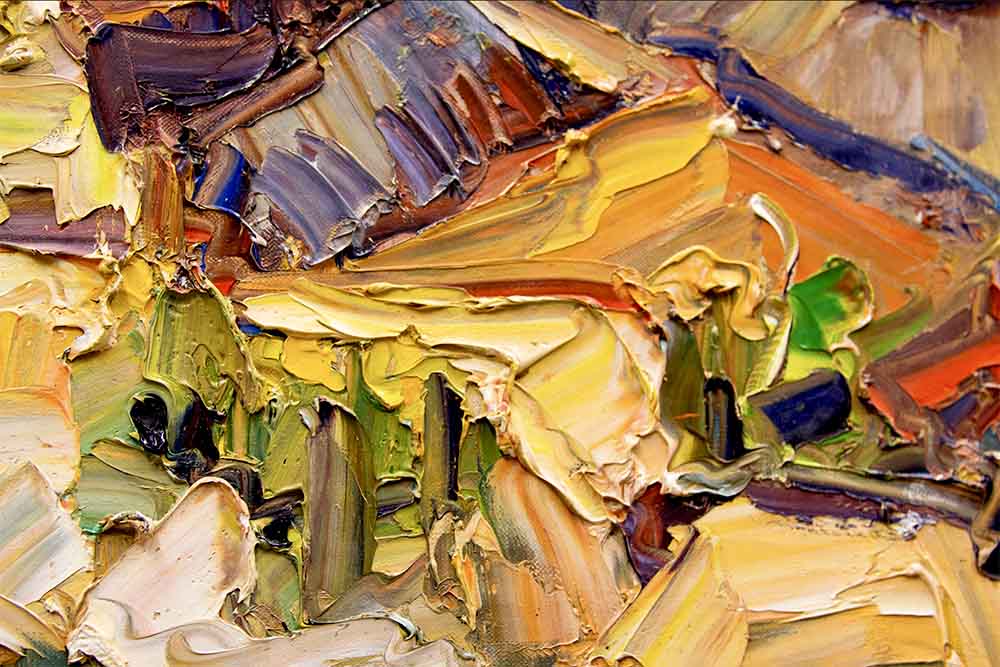
As a painter, Zalyvakha’s technique is highly textural, echoing
the wooly thickness of Hutsul weavings and regional folk art. The
vivid, richly saturated color threads of his paintings share in the
linear partitions found in the art of the traditional Ukrainian Easter
egg, the pysanka. Like the continuous line of infinity, Zalyvakha’s
paintings are imbued with the fluid momentum of limitless,
unhampered movement — the pulsing energetics of thought
passing through space, leaving traces of a subtle play of lights and
darks, a pensive psychologism, lost in primordial truths.
Thematically, his works address a broad range of existentialist
motifs — faceless crowds, bereaved mothers, martyred figures,
famine victims. Accumulated references to a sorrowful national
history weave through a supple web of intertwining lines that
immediately remind one of restrictive prison grates, from which
color breaks through in an unceasing flow of positive energy. His
form is abstract, without relinquishing the literalness of redemptive
content. The appropriated reference to the icon of the Theotokos
(Mother of God) sublimate scenes of agony and incarceration into
a visual prayer of liberation. The energetics of spirit is revealed by
an overriding verticality in Zalyvakha’s compositions. This soaring
quality — what the artist called “Gothic Constructivism” — points
to a distinct surge of color and form. At times, it is a wavelike rush
upward; at others, it presents itself as a rolling swell that has not yet
peaked or reached its bursting point.
Despite continuous persecution through the 1970s and into the first
half of the 1980s, Zalyvakha was a prolific painter; when the Artists’
Union made it impossible for shunned artists to secure paint and
paintbrushes, he turned his attention to woodcuts and linogravures
and became a master ex librist, memorializing his contemporaries
from one of the darkest chapters of modern Ukrainian history.
Prof. Myroslava M. Mudrak
The Ohio State University
This exhibition was organized in cooperation with the Plast Ukrainian scouting sororities
Pershi Stezhi and Verkhovynky.
# # #
About the Museum
The Ukrainian Museum was founded in 1976 by the Ukrainian National Women's League of America as a showcase for Ukrainian culture. Since its founding, the Museum has amassed extensive collections of folk art, fine art, and archival material. It mounts several exhibitions annually; publishes accompanying bilingual catalogues; organizes courses, workshops, and other educational programs; and hosts a variety of public events. In April 2005 the Museum moved into a new, state-of-the-art facility in New York's East Village, funded entirely by the Ukrainian American community.
|