|
|
Borys Kosarev: Modernist Kharkiv, 1915-1931
December 5, 2011 January 11, 2012
First Ever Exhibition of Kosarev Works
New York City, October 31, 2011 The first comprehensive exhibition of avant-garde artist
Borys Kosarev will be presented in New York City at The Ukrainian Museum, opening
December 4 and on display through May 2, 2012. Borys Kosarev: Modernist Kharkiv, 1915-1931
includes 82 works on paper by Kosarev, an important contributor to the Eastern European
Modernist movement and a survivor of Stalin's intellectual purges in 1930s Ukraine.
Borys Kosarev (1897-1994), also known as Boris Kosariev, was a contemporary of prominent
Kharkiv, Ukraine artists David Burliuk (1882-1967), Vladimir Tatlin (1885-1953), and Ilya
Repin (1844-1930), as well as other celebrated Ukrainian artists such as Kazimir Malevich
(1879-1935) and Alexander Archipenko (1887-1964). A master graphic artist, painter, designer,
photographer, and book illustrator, Kosarev worked with luminaries such as theater director Les
Kurbas (1887-1937), poet Vladimir Mayakovsky (1893-1930), and cinema pioneer Alexander
Dovzhenko (1894-1956). One of Kosarev's closest
collaborators in the Kharkiv avant-garde was Volodymyr Bobrytskyi (1898-1986), who emigrated
to New York and went on to become the recognized designer known as Bobri.
"Kosarev is barely known in his own country. This first ever exhibition brings to light Kosarev’s
prodigious talent and exposes the fundamental relationship between the artist and the site of his
creative stimulus, his beloved city, Kharkiv," said Maria Shust, director of The Ukrainian
Museum. "Kosarev's extensive contribution to Ukrainian Modernism will finally be given its due when the collection is exhibited in Ukraine,
where it will return in 2012."
Borys Kosarev’s name will forever be associated with the city of Kharkiv the place of his birth,
death, and a long life devoted to the visual arts. A native son of the fiercely independent Kharkiv
territory, which produced some of Ukraine’s most creative cultural personalities, Kosarev
epitomizes the spirit of the area and its regional diversity. The contents of the exhibition coincide
with the period of Kharkiv’s status as Ukraine’s capital city (1919-1934) and the rise of
Constructivism as an ideological aesthetic. It was also the period of Ukrainianization—a
government policy that encouraged the revitalization of national culture, only to be quashed
through a series of orchestrated purges of its proponents, the Ukrainian intelligentsia, beginning
in the 1930s. While it flourished, Ukrainianization brought with it a renaissance of art and
culture, serving as an unprecedented gateway into global Modernism through the aesthetic of
Constructivism.
Sheltered from excessive official scrutiny by working in theater design and as a teacher until his
death in 1994, Kosarev survived the Stalin purges and later repressions by intentionally
"flying under the radar." Sadly, his own reticence, coupled with the pressures exerted by the
political landscape of the times, left Kosarev virtually unknown as a contributor to the Modernist
movement. Not unlike Anatol Petrytsky (1895-1964), whose works were called a "serendipitous
discovery" by the New York Times (Glueck, Grace. “Ukrainian Modernists, All Alone, Here at
Last.” The New York Times, November 4, 2006, B7), Kosarev and his art are yet to be revealed
and considered among the important Modernists of the early 20th century.
Borys Kosarev: Modernist Kharkiv, 1915-1931 is augmented with several works by his
colleagues Vasyl Yermilov (1894-1968) and Maria Syniakova (1890-1984). The exhibition,
comprising 88 objects in total, is curated by Myroslava M. Mudrak, Professor of Art History,
The Ohio State University.
Organized by The Ukrainian Museum (New York), the Kharkiv Art Museum (Ukraine), and
Rodovid Gallery (Ukraine), the objects in this exhibition are drawn from the collections of Nadia
Kosareva (Kharkiv), the Museum of Theatre, Music and Cinema Arts of Ukraine (Kyiv), the
Kharkiv Art Museum, Borys and Tetiana Grynyov (Kharkiv), the VovaTania Gallery (Kharkiv),
Dmytro Horbachov (Kyiv), and Oleksander Myzhin (Kharkiv). Borys Kosarev: Modernist
Kharkiv, 1915-1931 is accompanied by a catalogue authored by Professor Mudrak with
additional essays written by Tetiana Pavlova and Valentyna Chechyk, who co-authored the 2009
monograph Borys Kosarev 1920s: Vid Maliarstva do Tea-Kino-Photo (Borys Kosarev 1920s:
From Painting to Thea-Cine-Photo). The exhibition is funded in part by the Stedley Art
Foundation (Ukraine) and individual sponsors in the United States.
About the Museum
The Ukrainian Museum acquires, preserves, and exhibits articles of artistic or historic
significance to the rich cultural heritage of Ukrainian Americans; its collections include
thousands of items of folk art, fine art, and archival material. At its founding in 1976 by the
Ukrainian National Women’s League of America, the Museum was hailed as one of the finest
achievements of Americans of Ukrainian descent. Since then, and particularly since its move in
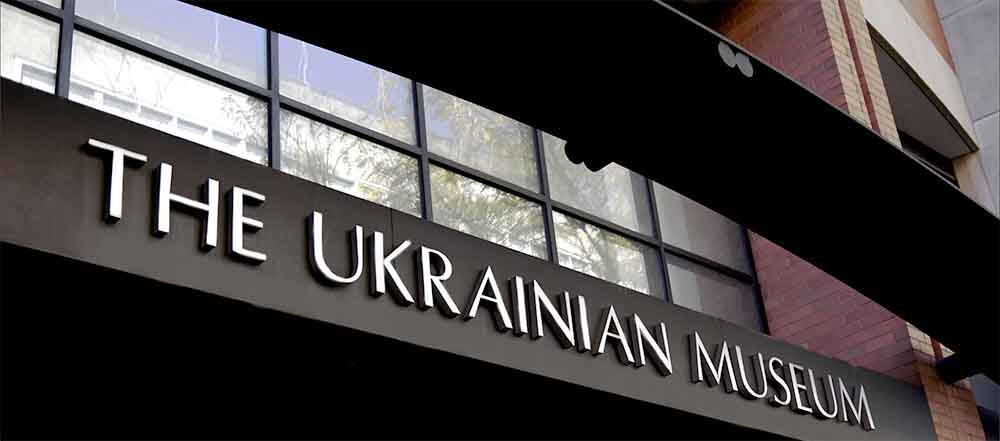
2005 to a new, state-of-the-art building in Manhattan’s vibrant East Village, it has become
known as one of the most interesting and dynamic smaller museums in New York City. Each
year, the Museum organizes several exhibitions, publishes bilingual (English/Ukrainian)
catalogues, and presents a wide range of public and educational programs, including concerts,
films, lectures, courses, workshops, and special events.
* * *
The Ukrainian Museum
222 East 6th Street (between Second and Third Avenues)
New York, NY 10003
T: 212.228.0110
F: 212.228.1947
info@ukrainianmuseum.org
www.ukrainianmuseum.org
Museum hours:
Wednesday–Sunday, 11:30 a.m.–5:00 p.m.
Gift Shop * guided tours * school and family programs * reduced admission for students and seniors
|